
In the vast expanse of the Quantum Realms, where time behaves more like a river with multiple currents than a straight line, lies the Court of Remembered Futures. This is the domain of the Chronomancer Twins.
Threads of Destiny
Seated at a massive, ornate timepiece, the twins do not simply watch time pass; they manage it. They ponder which threads of time to pull and which to leave woven. It is a weight beyond measure, for every decision they make will either cage a future or free a present.
They are not alone in this task. Their feline familiars, the Tabby-Seers, offer silent counsel by reading the patterns of the checkerboard floor. Above them, the galaxy spirals in a torrent of starlight—a constant reminder of the cosmic stakes at play.
This piece, part of the Animals That Knew Too Much series, explores the quiet pressure of decision-making and the beauty of a universe that remembers itself. We invite you to stay a moment in the Court and listen to the liquid memories as they cascade like stars.
If you’ve spent any time with my work, you’ve probably noticed they keep showing up: cats, clocks, and balloons. Sometimes they’re obvious. Sometimes they’re half-hidden, watching from the edges or floating just out of reach. People ask me all the time if they “mean something.”
They do—but not always in the way symbols usually behave.
Cats are often linked with or symbolize cycles of death and renewal. This is thanks to myths about “nine lives” and their calm relationship with stillness. They are also linked with moving between worlds. But more than this, my cats are witnesses. They’re independent, observant, and quietly defiant. Cats don’t act for you; they exist alongside you. In my work, they represent intuition, curiosity, and the parts of ourselves that refuse to be controlled or fully explained. They move freely through strange spaces, unbothered by warped architecture or impossible logic, because they belong there. In many ways, they’re stand-ins for the viewer—here, alert, and slightly suspicious of what’s unfolding.
The clocks are about time, but not productivity time or calendar time. They’re about felt time. Memory time. The way moments stretch, loop, collapse, or refuse to stay where we put them. The clocks in my work sometimes crack, melt, or hover. They even break apart. That’s how time actually behaves when emotion is involved. Trauma, nostalgia, ritual, creativity—none of them obey a straight timeline. The clocks are reminders that the past is never really gone, and the future is never fully stable. And that our time here, our very lives, are very short in the grand scheme of things. Our lives are precious fleeting gifts.
And the balloons—they’re the most deceptive of the three. They look playful, light, almost innocent. But balloons are about tension. They float because something is pulling against gravity. They’re always one moment away from drifting off or bursting. In my work, balloons represent hope, fragility, and the strange optimism we carry even in dark or absurd situations. They are my prayers. They are joy with a threat attached. Celebration with a countdown.
Together, these elements form a personal visual language. I’m not asking viewers to decode them into a single answer. I’m asking them to feel them and define them for themselves. To recognize something familiar but slightly off—like a dream you’re sure you’ve had before, but can’t quite place.
They keep appearing because they belong to the world within my mind. They also keep appearing in my own surrealistic thinking. A world where logic bends, time misbehaves, the silent observers of my meta-mind lurk quietly, and beauty exists alongside unease. Once you step into that space, those symbols will never leave you alone anymore. And honestly?
For a long time, people believed the only path to success ran straight through a college campus. A degree was the ticket to opportunity, financial security, and social respect. But today, the world works differently. Technology, entrepreneurship, and the creator economy have opened countless doors that don’t require a diploma hanging on the wall.
This doesn’t mean college has no value—it simply means success has more than one road leading to it.
Passion, curiosity, and grit matter more than credentials
Many of the world’s most impactful innovators didn’t complete college. They succeeded because they were relentless learners, problem-solvers, and risk-takers. They built skills outside the classroom through curiosity and experimentation. What propelled them wasn’t a degree—it was drive.
Today, opportunities to self-educate are everywhere: online courses, boot camps, mentors, apprenticeships, YouTube, community groups, and hands-on projects. If you want to learn a skill, build a business, create art, or solve a problem, almost nothing stands in your way.
The world rewards value, not paperwork
Across many careers—tech, design, marketing, writing, sales, entertainment—what really matters is what you can do. A great portfolio, a strong work ethic, and the ability to execute consistently will beat a transcript every time.
Clients want results. Employers want capability. Audiences want connection. None of those things require a degree.
Nontraditional learners often thrive outside academia
Some people simply learn better by doing, not by sitting through lectures. For them, freedom, hands-on experience, and real-world trial-and-error lead to faster mastery than a classroom ever could.
College is one path to growth. But it’s not the only one—and for countless people, it’s not even the best one.
Success is personal—not standardized
The core truth is simple: success comes from skill, persistence, creativity, confidence, and resilience. If you can cultivate those qualities, you can build a fulfilling and prosperous life with or without a degree.
College can help you, but it is not your destiny. Your choices, your effort, and your growth are.
Here are 25 well-known achievers—from technology, business, the arts, activism, and sports—who reached extraordinary success without completing a college degree:
Technology & Business
Steve Jobs — Co-founder of Apple; dropped out of Reed College.
Bill Gates — Co-founder of Microsoft; left Harvard to start the company.
Mark Zuckerberg — Founder of Facebook; left Harvard during sophomore year.
Larry Ellison — Co-founder of Oracle; dropped out of two universities.
Michael Dell — Founder of Dell Technologies; left University of Texas to build PCs.
Evan Williams — Co-founder of Twitter & Blogger; left University of Nebraska.
Jan Koum — Co-founder of WhatsApp; dropped out of San Jose State.
Travis Kalanick — Co-founder of Uber; left UCLA.
Daniel Ek — Founder of Spotify; skipped college to build companies.
Richard Branson — Founder of Virgin Group; left school at 16.
Entertainment & Media
Steven Spielberg — Iconic director; dropped out of college (later finished degree decades afterward).
Quentin Tarantino — Film director; never attended college.
Jay-Z — Rapper, entrepreneur, billionaire; did not attend college.
Eminem — Multi-platinum rapper; never attended college.
Oprah Winfrey — Entertainer and media mogul; left Tennessee State University before graduating.
Ellen DeGeneres — Comedian and TV host; left University of New Orleans.
Tom Hanks — Actor; left Sacramento State to pursue acting.
Science, Innovation & Social Impact
Thomas Edison — Inventor; no formal higher education.
Henry Ford — Founder of Ford Motor Company; no college degree.
Walt Disney — Animation and entertainment pioneer; left school at 16.
Frank Lloyd Wright — Legendary architect; never earned a college degree.
Maya Angelou — Renowned author and civil rights activist; never attended college.
Sports & Public Figures
(photo taken by photographer Joshua Massel. source and express permission to use at Wikipedia is at flickr here: {{Cc-by-sa-2.0}} )
Michael Jordan — NBA legend; left UNC early to join the NBA (later returned to finish).
LeBron James — Entered the NBA from high school; built a business empire without college.
Kobe Bryant — Entered the NBA directly from high school.
Ultimately, the stories of great achievers without college degrees remind us that success is not a one-size-fits-all journey. It is shaped by personal strengths, passions, environments, and opportunities. A degree can be helpful, but it is not destiny. What matters most is the commitment to grow, to innovate, and to persist. Those qualities—not the possession of a diploma—are what lead to extraordinary accomplishment.
There are many other successful individuals. Who can YOU add to the list?
Welcome to Stoneworks — a creator-led, community-powered ecosystem where art, technology, and imagination meet.
This is more than a token. It’s a shared experiment in building something lasting, beautiful, and alive.
Every piece of art I create — every glitch, cat, clock, and checkerboard spiral — is part of a growing world. And Stoneworks is the foundation that holds it all together. It connects collectors, supporters, and dreamers into a single creative network, where value is built by participation, not permission.
The Vision:
Stoneworks exists to empower my supporters to become co-builders of this world. By holding and using the Stoneworks token, you’re not just collecting art — you’re investing in the growth of a creative movement.
To reward loyalty with genuine utility — digital art drops, physical prints, and behind-the-scenes access.
To keep the token economy transparent, fair, and built on real artistic value.
To grow together — every milestone shared, every drop meaningful, every reward earned.
The Stoneworks token will live on the Access Protocol (ACS) / Solana blockchain, designed for sustainability, creativity, and long-term community growth.
This is our foundation. This is how we build something real.
Art evolves. Communities grow. Stoneworks is where both collide.
⚙️ Community Announcement: The Stoneworks Era Begins
I’m officially preparing to launch the Stoneworks Token ($STO) on the Access Protocol network — the next step in building a sustainable, community-driven art economy.
Early ACS supporters and subscribers to my Access Hub will form the core founder circle — the first group to help shape the Stoneworks economy from the inside out.
🌀 Early Supporter Airdrop: Reserved for my earliest ACS stakers and most active community members.
💎 Founders NFTs: Exclusive tokens for Stoneworks holders that grant ongoing rewards and access.
🎨 Utility & Access: Use tokens to unlock art drops, raffles, behind-the-scenes studio access, and merch discounts.
🗳️ Future Governance: Holders will eventually help decide themes, artwork selections, and drop schedules.
The Stoneworks ecosystem will always center on one thing — connection through creativity. Together we’ll experiment, refine, and grow this economy into something that truly represents us.
I’ll be sharing the roadmap and pre-launch milestones on my website , MichaelStoneArt.com and across socials.
If you’re already subscribed — you’re early. If not — this is your moment to join before the foundation solidifies.
Welcome to Stoneworks — where imagination becomes infrastructure.
Art has always been about connection. For me, creating a piece isn’t just about the brushstrokes, the symbols, or the layers of surreal detail — it’s about the people who bring that work into their lives. That’s why I designed a release system where every week and every month brings something new for my community. It keeps the rhythm alive, rewards loyalty, and turns collecting into an ongoing experience rather than a one-time event.
Weekly Drops: The Open Door
Every week, I release new open editions. These are artworks designed to be accessible to anyone who wants to step into the world of Stone Style. Open editions let more people collect without worrying about scarcity or missing out. They’re my way of saying, “The door is always open.” Each drop is fresh, surprising, and sometimes even experimental — a chance for me to share works that pulse with energy, even if they’re not destined to be rare 1-of-1s.
For collectors, weekly drops are a chance to stay connected. You can track the evolution of motifs like cats, clocks, masks, and red balloons as they move across different pieces. Week by week, the Stone Style universe grows wider.
Monthly 1-of-1s: For the Dedicated Few
Once a month, I release a true 1-of-1 — a singular piece that no one else will ever own. These works carry the weight of uniqueness, a kind of permanence in a digital and physical world that moves fast. They’re designed for my most dedicated supporters, the ones who believe in the long arc of what I’m building.
Owning a monthly 1-of-1 isn’t just about exclusivity; it’s about trust. It’s knowing that you’re part of the inner circle, helping fuel the continuation of Stone Style, and carrying a piece of that story forward.
Raffles, Surprises, and Fairness
Community shouldn’t just mean a hierarchy of who can buy what. That’s why I’ve built in raffles, giveaways, and surprise rewards. Sometimes it’s about recognizing a top supporter. Other times it’s about giving a chance to someone who’s just starting their collection. This balance keeps things exciting and fair.
The unpredictability mirrors my art itself — surreal, layered, full of unexpected turns. You never quite know when the next red balloon will float into view.
The Role of the STONE Token
All of this ties into the STONE token, which will act as both a symbol and a tool, once I’m able to launch it. Tokens allow supporters to stake value, access rewards, and strengthen their place in the ecosystem. They aren’t just digital numbers; they represent participation in something bigger. Until then you can support my Michael-Stone token launch at Access Protocol’s
I am designing the Polygon-based STONE token so that it will grow alongside my art. The more the community engages, the more meaningful each token will become. It’s not speculation — it’s connection.
Why I Am Building It This Way
I don’t want my art to exist in a vacuum, waiting for a gallery wall or a single transaction. I want it to be alive, circulating, sparking conversation, rewarding the people who believe in it. Weekly drops, monthly 1-of-1s, raffles, and the STONE tokens all fit into that vision, whether I’m talking about the Polygon-based STONE token (which is currently on hold) or the ACS/Solana based Michael-Stone token.
These are systems that say: collecting should be fun. It should be rewarding. And most of all, it should feel like being part of a living, breathing movement.
Closing Thought
Every artwork I release is also a thank-you. To the people who collect, who share, who watch my cats and clocks multiply across canvases and screens — you are part of the Stone Style.
Ready to join in? Check out my latest drops, watch for the Polygon-based STONE token, explore the ACS-based Michael-Stone token, and step into the evolving universe of Michael Stone Art. And as always, follow @MichaelStoneArt on X.com and @mibesto803 on Instagram. You’ll find my work on Foundation.app, dripHaus, and Access Protocol- as well as various other NFT platforms including Rarible, Tensor, OpenSea, exchange.art, and ZeroOne.art.
I’ve been hearing the question a lot lately: “Are NFTs dead?” My short answer is no—but things have definitely shifted.
When NFTs first exploded, fine art NFTs looked like a revolution. Artists suddenly had a way to sell work directly to collectors, with built-in proof of ownership. That’s still true, but the hype cooled once speculation got louder than the art itself. Today, fine art NFTs live on in smaller communities where people value the creative vision more than the resale.
Then you have collectible NFTs—the PFPs, trading cards, and gamified drops. At one point, everyone was launching them. Too many projects promised the world, and when most didn’t deliver, prices collapsed. But in the middle of all that noise, you’ll still find a few gems: projects that actually build culture or connect meaningfully with their communities.
And finally, there are tokens by themselves, without the art. These are starting to blend into the bigger world of digital finance. They act like access keys, voting rights, or little building blocks of new markets. Here, the focus isn’t art at all—it’s about infrastructure, and how tokenization might change how we handle value online.
So no, NFTs aren’t dead. The hype era is over, and maybe that’s a good thing. What’s left is quieter, slower, and maybe more meaningful—art as provenance, collectibles as culture, tokens as financial tools. That’s where I see things heading, and I’ll keep exploring it right alongside you.
What do you think—are NFTs still alive in your world?
I’ve been working for weeks to get the STONE token fully tradable. Liquidity pool, fair price, collector-friendly. You know — the real stuff. I want folks who support my art to actually use the token. Trade it. Hold it. Use it for perks. Redeem it for weird things.
And I almost had it. The token is real. The contracts are live. But…
Polygon (the blockchain we’re using) is in the middle of this awkward rebrand. They’re switching from “MATIC” to a new token called “POL.” Sounds simple, right? Nope.
Turns out, everything still requires MATIC for gas. But the apps — like Uniswap — keep pushing POL instead. The result? Constant errors. Can’t swap. Can’t build the liquidity pool. Can’t even pay to fix it unless you already have MATIC… which is surprisingly hard to get unless you know exactly what you’re doing.
So for now?
I’m keeping the STONE token safely tucked away in my personal wallet — no pool, no market price, no chaos. Just calm. Controlled. Waiting.
But it’s not over.
The moment the ecosystem gets its act together — or the moment I get my hands on some good old-fashioned MATIC — the STONE economy will go live. You’ll be able to grab STONE, use it to unlock stuff, and take part in a new kind of collector-powered system I’ve been dreaming about for months.
Want to be part of the early test group? Shoot me a message. If you’re holding STONE (or want to), I’ll make sure you’re on the inside when the gates finally open.
Until then, thanks for your patience. I’ll keep building.
Hey there, fellow art lovers! Ever feel like making art is more fun when it’s just for you? There’s this cool saying that nails it: “Blessed are those artists who don’t have to rely on art as their primary source of income, for they will learn to love their art for its own sake.”
It’s like a little reminder that true joy in creating comes from the heart, not the wallet.Think about it. When bills don’t ride on your next painting or sketch, you paint what lights you up. No pressure to chase trends or sell out. You experiment freely. You play with colors and shapes just because they feel right.
But hey, if you’ve got a day job, art becomes your happy escape. You create for the thrill, not the paycheck. And guess what? That freedom often makes your work even better.Here are some quick perks of loving art just for you:
More fun every day: No stress means more smiles while you draw.
Bolder ideas: Try wild stuff without fearing it won’t sell.
Longer passion: It sticks around for life, not just until the next rent check.
Better connections: Share your heart-felt pieces and bond with true fans.
That’s pure magic. It keeps your spark alive and stops burnout from sneaking in.Sure, making money from art is awesome. But when it’s your only gig, it can turn fun into a grind. Deadlines loom. Critics’ words sting more.
Want proof? Check out Beeple, a super successful NFT artist. His wild digital worlds started as daily doodles for fun. Now they’re huge hits. Peek at his artwork here: Beeple’s Everydays.So, grab your brushes or pens today. Create because it makes you happy. The rest? It’ll follow if it’s meant to.
What’s your favorite way to play with art? Drop a comment—I’d love to hear!
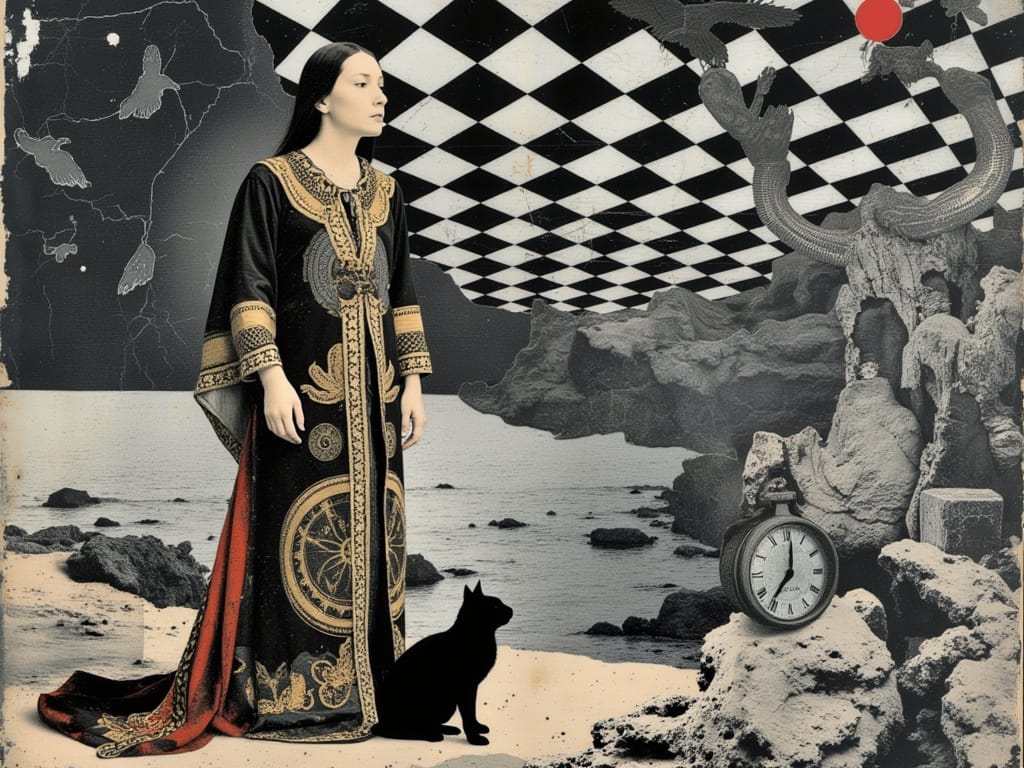
An enigmatic figure sits suspended in ritual silence, as clocks, cats, and a single balloon weave together symbols of time and fragility.
I wanted to take a moment to share a quick update about everything that’s been going on in my world lately. As many of you know, I try to keep things moving across a lot of different fronts—and though it’s been a busy stretch, I’m really excited about where things are heading.
First, the website is getting some love. I’ve been working behind the scenes to polish up the store and the site as a whole so it’s easier to navigate and (hopefully!) more fun to explore. My goal is to make it not just a shop, but a place where you can always find new work, updates, and insights about the creative process.
On the art-sharing side, I’ve been keeping up with my Access Protocol drops and my drip.Haus shares—regular ways to get my work out there to collectors and supporters. Both of these platforms have been great for building consistency, and I’m learning a lot about what works (and what doesn’t) in terms of connecting with new audiences.
Outside the studio, I’ve been busy with schoolwork (yes, I’m still cranking through assignments!) and also with volunteering at conventions. Both of these keep me connected to the wider creative and fan communities, and I always walk away feeling recharged and inspired.
On a personal note: I’m recovering from a recent bout with pneumonia. It slowed me down for a while, but I’m on the mend now and easing back into my usual pace. If you’ve been wondering why things seemed a little quieter than usual, that’s the reason—but I’m happy to be bouncing back.
And now I’d love to hear from you: what’s been working (and not working) for you when it comes to promoting and selling your art or creative projects? I know I’ll be reflecting on this myself right here in the blog—sharing what I try, what clicks, and what I’d do differently. It would mean a lot to hear your experiences too, so we can learn and grow together as a community.
Thanks, as always, for being part of this journey with me. Your support is what makes all of this possible.